


The Science Behind Startup Jungle
A four-dimensional business modelling method based on academic research.
Academic Background
Startup Jungle is a four-dimensional business modelling tool developed and studied within academic research in entrepreneurship and innovation.
The method has been used in Master’s level education at the University of Gothenburg and published in the Journal of Business Models.
Citation:
Rumble, R. (2019). The Startup Jungle: Four-dimensional Business Modelling.Journal of Business Models, Vol. 7, No. 3, pp. 25–36.
Why Flat Tools Fall Short
Traditional business modelling tools — such as slides, canvases, and digital boards — are typically two-dimensional.
While they are easy to use and share, research shows they struggle to:
-Represent complex interdependencies
-Capture execution instead of ideal outcomes
-Model change over time
-Support scenario planning in a natural way
Startup Jungle addresses these limitations by moving beyond flat representations.
Four Dimensions: Space + Time
Startup Jungle introduces time as a fourth dimension.
Instead of creating multiple versions of a business model, teams physically reposition elements to explore:
-Consequences of decisions
-Stakeholder reactions
-Path dependency over time
-Multiple future scenarios
This dynamic “interplay” shifts the focus from describing a business to understanding how it evolves.
Visual Management & Embodied Cognition
The method builds on principles from:
-Visual Management
-Embodied Cognition
-Serious Games
By using physical space, movement, and tangible objects, teams:
-Understand complex systems faster
-Align through shared visual language
-Engage more deeply than with verbal discussion alone
Research shows that learning and decision-making improve when multiple senses are involved.
The Jungle Metaphor
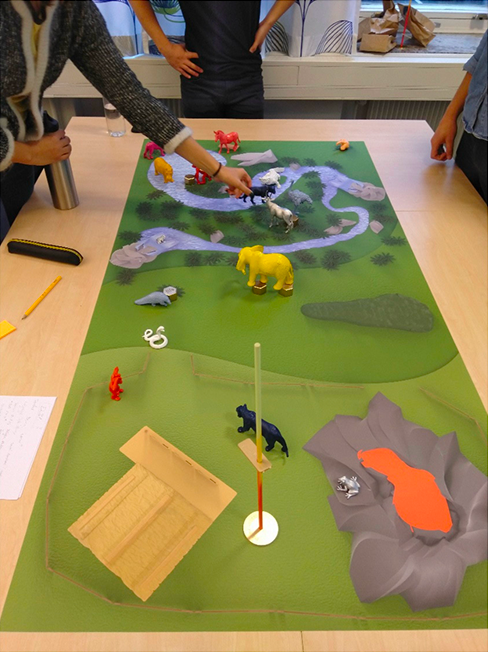
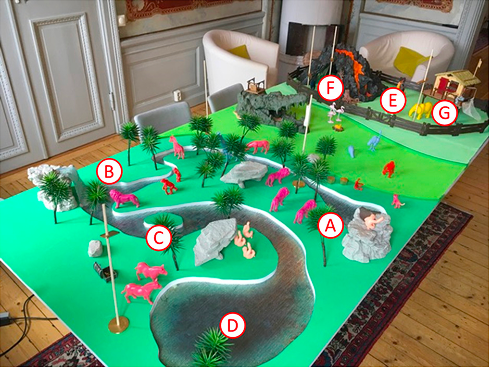
The jungle landscape is not decorative — it is theoretically embedded.
It represents:
-Business ecosystems
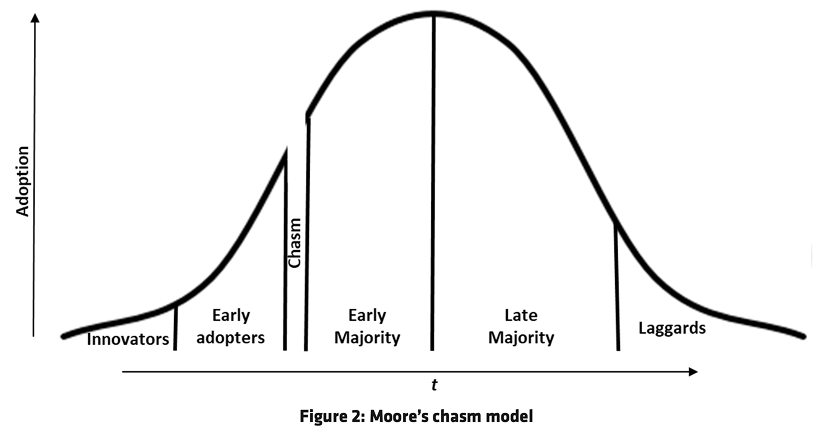
-Customer adoption over time
-Internal vs external actors
-Resources, constraints, and collaboration
Animals act as metaphors for stakeholders, enabling teams to discuss complex strategies using a shared, intuitive language.

Proven in Practice
In academic settings, Startup Jungle has shown:
-Higher perceived usefulness than traditional tools
-Strong engagement and participation
-Improved sensemaking and strategic clarity
Students rated the tool 4.4 out of 5, with no negative ratings.
The method is now also used in corporate strategy and innovation sessions.